

IPTV for FIFA Live Matches 2026: Avoid These Mistakes
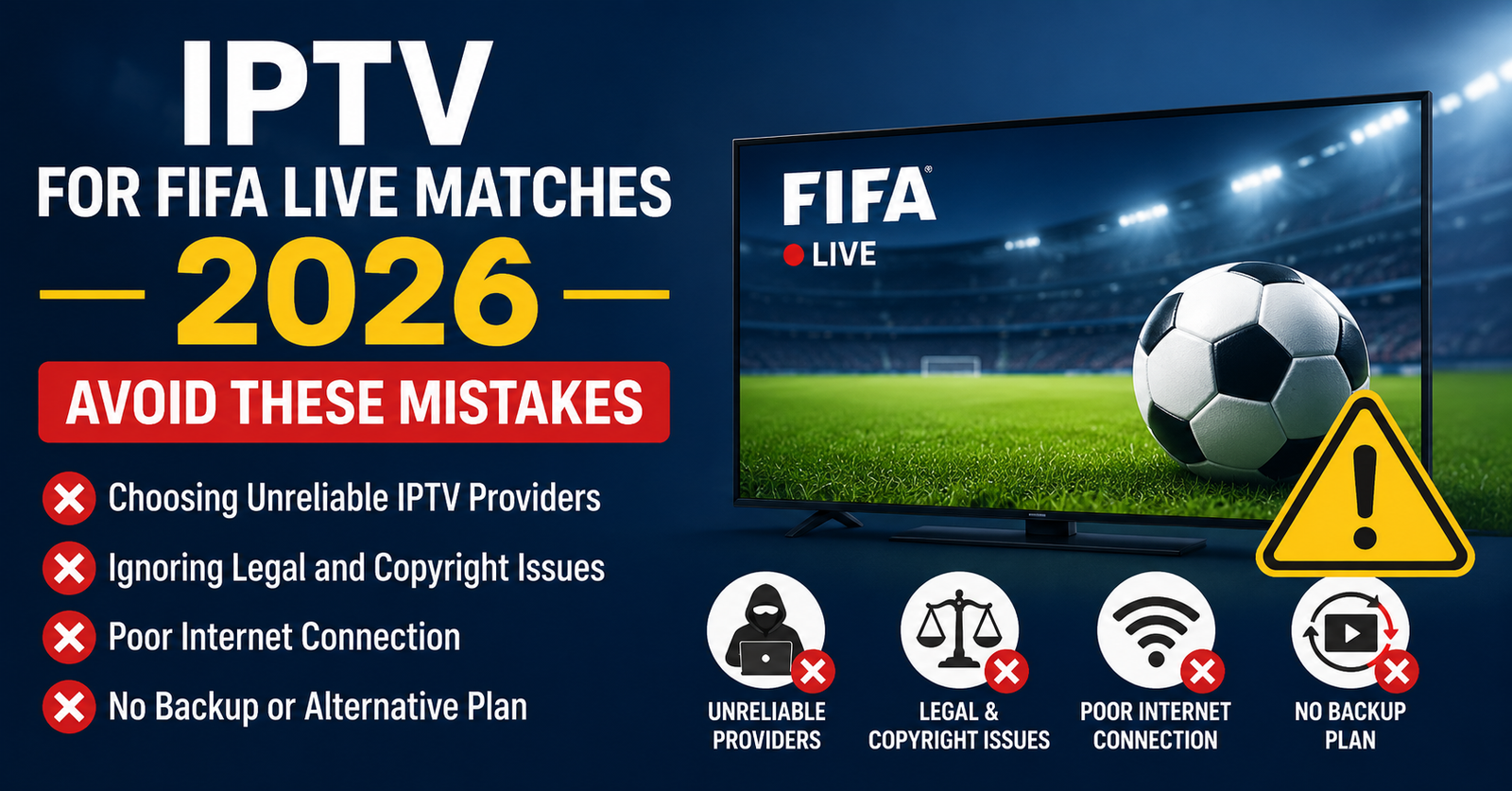
The Mistake That Gets Made Every Four Years
Every major tournament, the same thing happens. Someone signs up for a cheap IPTV subscription two days before the opening match, everything looks fine during testing, and then the stream freezes at the worst possible moment — a penalty kick, an injury-time goal, or a VAR decision. By the time they’ve refreshed the app and reconnected, the moment has gone.
IPTV for FIFA live matches in 2026 works — but only when the underlying infrastructure can handle what a World Cup does to traffic. That’s the part most buyers never think about until it’s too late.
The short answer: a premium IPTV subscription from a provider with multi-source delivery, failover routing, and dedicated sports infrastructure will handle FIFA live matches reliably. A cheap, single-server provider almost certainly won’t.
Why FIFA Traffic Breaks Most IPTV Providers
A standard IPTV server handles a predictable load. Sport events — particularly FIFA World Cup matches — are different. All subscribers watch the same channels simultaneously, at the same moment, with zero tolerance for buffering.
During the 2022 World Cup, we saw providers with no load balancing lose 30–40% of their active streams within the first ten minutes of high-profile matches. The infrastructure simply wasn’t designed for simultaneous peak demand.
What separates providers who survive FIFA live matches from those who don’t:
- Multi-source delivery: Multiple content feeds from different uplinks, not a single source
- Load balancing: Traffic distributed across server clusters rather than a single node
- Automatic failover: If one stream source drops, viewers are redirected without manual intervention
- CDN routing: Geographically distributed delivery reduces latency for UK and international viewers
- Active monitoring: Engineers watching stream health in real time during high-demand events
If your current provider can’t clearly explain how they handle peak sports traffic, that’s your answer.
What IPTV for FIFA Live Matches Actually Requires in 2026
Minimum Internet Speed for Stable Streaming
| Stream Quality | Minimum Speed Required | Recommended Speed |
|---|---|---|
| SD (Standard Definition) | 5 Mbps | 10 Mbps |
| HD (720p / 1080i) | 10 Mbps | 20 Mbps |
| Full HD (1080p) | 15 Mbps | 25 Mbps |
| 4K Ultra HD | 25 Mbps | 50 Mbps |
These are per-stream figures. If multiple people in a household are watching different matches simultaneously, multiply accordingly.
Device Compatibility for FIFA 2026
IPTV for FIFA live matches in 2026 works across most modern devices, but performance varies significantly:
- Amazon Firestick / Fire TV: Strong performance with most IPTV apps, but older generation models struggle with 4K
- Android TV / Google TV: Excellent compatibility, especially with Smarters Pro or TiViMate
- Smart TVs (Samsung, LG): Dependent on app availability; Samsung’s Tizen OS has tighter restrictions than LG’s webOS
- Apple TV: Requires specific apps; not all IPTV apps are available on tvOS
- Tablets and mobile: Reliable for personal viewing, though sustained 4K on mobile data remains impractical
Pro Tip:
For FIFA live matches, hardwire your streaming device to your router using an Ethernet adapter wherever possible. Wi-Fi congestion during high-demand events in residential areas is a real problem that no IPTV provider can solve on their end.
How ISP Behaviour Changes During Major Sports Events
This is something that doesn’t get discussed openly enough. During major sporting events like the FIFA World Cup, ISP throttling activity increases — not necessarily targeted at IPTV specifically, but as a result of network congestion management.
In 2022, we noticed unusual ISP behaviour across multiple UK providers during peak match windows. Sustained high-bandwidth streams to certain IP ranges were being throttled, not blocked, but slowed just enough to cause buffering at the worst moments.
There are two ways serious IPTV providers handle this:
DNS Routing: By routing traffic through alternative DNS configurations, providers can reduce the impact of ISP-level filtering. However, DNS poisoning — where ISPs or enforcement agencies corrupt DNS resolution to block specific destinations — remains a genuine risk for unlicensed providers in 2026.
VPN Consideration: Some IPTV users run a VPN to bypass ISP throttling during FIFA live matches. This can help with throttling, but adds latency. The trade-off is worth testing before the tournament begins, not during a live match.
What a Reseller Should Be Doing Right Now
For any IPTV reseller currently building or maintaining a customer base ahead of FIFA 2026, the tournament represents both the biggest opportunity and the biggest operational test of the year.
One reseller we worked with during a previous tournament lost nearly 200 customers in a single week — not because of content issues, but because their provider’s infrastructure wasn’t ready for simultaneous peak demand. The customers didn’t understand infrastructure; they understood that it didn’t work during the matches they cared about most.
What Smart IPTV Resellers Are Preparing Right Now
- Verifying that their provider runs infrastructure load tests before major events
- Checking whether their reseller panel provides real-time stream health monitoring
- Pre-seeding customer communication with clear instructions for the FIFA period
- Reducing trial conversion friction so that interested viewers convert before peak demand
- Confirming that their panel credits won’t expire during the tournament window
An IPTV reseller panel that provides no transparency into stream health during a FIFA live match is a liability. If you can’t see what’s happening on your infrastructure, you can’t manage customer expectations or escalate problems quickly.
Pro Tip:
Before the FIFA 2026 tournament window opens, run a stress test by checking how your provider’s streams perform during any live Premier League or Champions League fixture. If there are buffering issues on a 40,000-attendance club match, a World Cup final with a global audience will be significantly worse.
The Infrastructure Behind Reliable IPTV for FIFA Live Matches
Single-Source vs Multi-Source Delivery
| Single-Source Infrastructure | Multi-Source Infrastructure |
|---|---|
| One content feed | Multiple redundant feeds |
| No failover | Automatic failover on drop |
| Server overload likely at peak | Load distributed across clusters |
| No CDN routing | Geographic CDN distribution |
| High outage risk during FIFA | Designed for simultaneous peak demand |
| No active monitoring | Real-time stream health monitoring |
The difference becomes irrelevant during low-demand periods. FIFA live matches expose it completely.
HLS Delivery and Latency During FIFA Matches
Most IPTV services use HLS (HTTP Live Streaming) delivery. Under normal conditions, this works reliably. During FIFA live matches, HLS segment size and buffer configuration become critical.
Providers who haven’t optimised their HLS delivery for sports events will experience what operators call “segment starvation” — the player requests the next video segment, the server responds too slowly, and the buffer empties. The result is the frozen screen viewers experience during crucial moments.
Serious providers reduce HLS segment sizes ahead of major sports events to allow faster recovery from micro-drops. Most cheap IPTV providers don’t make these adjustments.
Channel Coverage: What to Expect From IPTV for FIFA 2026
FIFA World Cup 2026 broadcasting rights vary by territory. In English-speaking markets:
- United Kingdom: BBC and ITV hold rights to free-to-air FIFA coverage
- United States: FOX Sports and Telemundo (Spanish)
- Canada: CTV, TSN, RDS
- Australia: SBS holds FIFA World Cup broadcasting rights
A legitimate IPTV subscription from a reliable provider will typically include these broadcast channels as part of standard UK and international channel packages. The quality of delivery depends entirely on the provider’s infrastructure, not the channel availability itself.
For resellers positioning services ahead of FIFA 2026, understanding which channels your subscribers are likely to search for — and confirming those channels are part of your provider’s offering — is basic panel management that should happen now, not the day before the tournament.
What Sub-Resellers Often Get Wrong Before Major Tournaments
After reviewing hundreds of support requests across multiple tournament cycles, one pattern appears consistently: sub-resellers underestimate how much the FIFA window accelerates customer churn — in both directions.
Done right, the World Cup brings new subscribers who discover IPTV for the first time. Done badly, it triggers mass cancellations from existing customers who experience failures during the matches they most wanted to watch.
Sub-resellers who operate with a minimal understanding of their own provider infrastructure are particularly exposed. They can’t communicate meaningfully about downtime, can’t provide accurate ETAs for resolution, and often respond to customer complaints with information they don’t actually have.
The IPTV operators who retain customers through a FIFA tournament are the ones who communicate proactively: scheduled maintenance windows, stream health updates, alternative channel sources if a primary feed drops.
Choosing the Right IPTV Provider for FIFA Live Matches 2026
Not every provider that claims to be FIFA-ready actually is. These are the questions worth asking before committing:
- Does the provider operate multi-source delivery or a single upstream?
- Is there automatic failover, or does manual intervention restart dropped streams?
- What load testing has been done ahead of FIFA 2026 specifically?
- Is there a dedicated support team active during live match windows?
- Does the reseller panel show real-time stream health for individual channels?
- What is the provider’s track record during previous major sports events?
Providers who can’t answer these questions specifically are telling you something important.
For UK IPTV resellers looking to establish a reliable foundation ahead of the tournament, britishseller.co.uk offers reseller infrastructure built around sports-event reliability rather than standard weekday demand.
FAQ: IPTV for FIFA Live Matches 2026
Does IPTV work for FIFA live matches in 2026?
Yes, IPTV for FIFA live matches in 2026 works reliably when the provider operates professional infrastructure. This means multi-source delivery, load balancing, and automatic failover. Budget providers with single-server setups frequently fail during simultaneous peak demand. Always test with a live sports event before committing to a full subscription ahead of the tournament.
Why does my IPTV buffer during FIFA live matches?
Buffering during FIFA live matches is almost always an infrastructure problem, not a device problem. The most common causes are server overload at the provider level, ISP throttling during peak network periods, weak home Wi-Fi (use a wired connection where possible), and HLS segment delivery delays. If your stream is stable on normal evenings but fails during major matches, your provider’s infrastructure isn’t built for peak simultaneous demand.
What internet speed do I need for IPTV FIFA live matches?
For standard HD streaming of FIFA live matches, a minimum of 10 Mbps is required per stream, with 20 Mbps recommended for stability. For 4K streaming, 25–50 Mbps is the practical range. These figures assume a wired connection. Wi-Fi performance varies significantly, particularly in areas with high residential network congestion during popular match windows.
Which devices support IPTV for FIFA live matches 2026?
IPTV for FIFA live matches in 2026 is compatible with Amazon Firestick, Android TV, Google TV, Samsung Smart TVs, LG Smart TVs, Apple TV, tablets, and mobile devices. Performance varies by device generation and app support. Android-based devices generally offer the widest IPTV app compatibility. Older smart TVs may require a separate streaming stick for full functionality.
How should an IPTV reseller prepare for FIFA 2026?
An IPTV reseller should verify infrastructure load-testing with their provider before the tournament, confirm reseller panel visibility into stream health, communicate proactively with subscribers about the FIFA window, reduce trial conversion friction in advance, and confirm that panel credits and active subscriptions cover the full tournament period. Resellers who prepare operationally rather than waiting for problems to emerge retain significantly more customers through major events.
Will a VPN help with IPTV during FIFA live matches?
A VPN can help bypass ISP throttling during FIFA live matches, but it introduces additional latency. The trade-off varies by ISP and location. Testing before the tournament is essential — enabling a VPN mid-match to fix buffering typically makes the experience worse before it improves. If ISP throttling is a consistent issue, a VPN configured in advance is a reasonable mitigation.
Can sub-resellers offer FIFA IPTV subscriptions?
Yes. A sub-reseller operating under an IPTV reseller panel can allocate subscriptions and trials ahead of FIFA 2026 using their existing panel credits. The key consideration is that the sub-reseller’s stream reliability depends entirely on the upstream provider’s infrastructure, not the sub-reseller’s own systems. Choosing a parent reseller with proven sports-event infrastructure is the most important decision a sub-reseller can make before the tournament.
Is IPTV for FIFA live matches legal in the UK?
Watching FIFA live matches via IPTV is legal when accessing licensed broadcast channels — BBC iPlayer, ITVX, and other authorised streams. Accessing live sports content through unlicensed IPTV services carrying paid broadcast rights without authorisation raises legal questions under UK copyright law. Subscribers should verify what their provider is licensed to distribute. This is a question for each individual to assess based on their own circumstances.
Success Checklists
IPTV Subscribers
- Test your IPTV stream on a live sports event before FIFA 2026 begins
- Confirm your internet speed meets minimum requirements for your chosen quality level
- Switch from Wi-Fi to a wired Ethernet connection where possible
- Update your IPTV app to the latest version before the tournament opens
- Know your provider’s support contact before you need it mid-match
IPTV Resellers
- Verify your provider’s infrastructure has been load-tested for simultaneous peak demand
- Confirm your reseller panel shows real-time stream health for individual channels
- Communicate the FIFA window to your subscriber base in advance
- Check that panel credits and active subscriptions cover the full tournament period
- Reduce trial subscription friction — convert interested users before the opening match
- Prepare a short troubleshooting guide for customers to follow before contacting support
Sub-Resellers
- Confirm your parent reseller’s infrastructure track record during major sports events
- Understand what failover options your upstream provider has in place
- Set realistic expectations with your customer base about stream performance during peak FIFA windows
- Ensure your own panel credits are sufficient for the tournament window without interruption
- Have a direct escalation contact with your parent reseller ready before the tournament begins
Conclusion
IPTV for FIFA live matches in 2026 is a genuine option for anyone who wants flexible, multi-device access to the tournament — but only when the infrastructure underneath it is built for what a World Cup actually demands. The gap between a provider that handles FIFA traffic and one that collapses under it isn’t visible until the moment of peak demand. By then, the only option is damage control.
For resellers and sub-resellers, FIFA 2026 is simultaneously the highest-opportunity and highest-risk event of the year. The customers you retain through a flawless tournament experience are significantly more likely to remain long-term subscribers. The ones who experience failures during high-stakes matches rarely give a second chance.
IPTV for FIFA live matches works when the preparation happens before the first whistle, not after the first buffer.
Closing Insight:
The World Cup doesn’t expose IPTV weaknesses — it simply accelerates what was already there. A provider that struggles on a busy midweek fixture night will fail completely during a simultaneous global audience event. The most useful thing any subscriber, UK IPTV reseller, or sub-reseller can do right now is test under realistic load conditions while there’s still time to switch providers before the 2026 tournament window opens.