

Best World Cup Football IPTV Streaming Setup for 2026
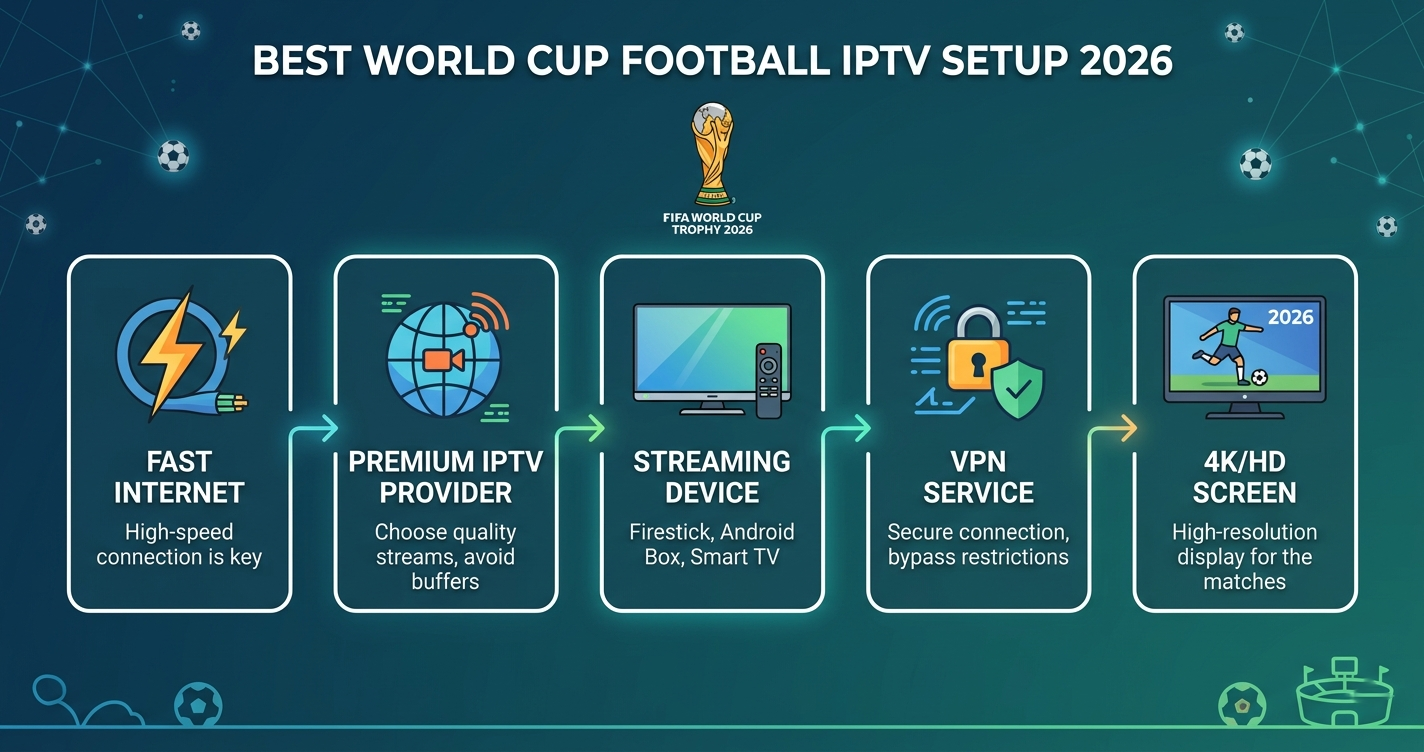
The 2026 FIFA World Cup is the first edition to span three countries — USA, Canada, and Mexico — with 104 matches scheduled across a full month. That is not just a football tournament. For IPTV operators, it is the single highest-concurrency streaming event most panels will ever face. And most of them are not ready.
World Cup football IPTV streaming in 2026 will put more simultaneous demand on servers than any previous tournament. The reason is simple: expanded format, more prime-time fixtures, more viewers, and significantly more IPTV subscribers than in 2022. If your provider could not handle the Euros without buffering, expect worse.
The short answer for subscribers: your current service will only survive this tournament if your provider has genuinely invested in infrastructure — redundant uplinks, load balancing, and CDN routing. If they have not, you will find out during the group stage at the worst possible moment.
Why World Cup Football IPTV Streaming Collapses at Kickoff
Every major tournament reveals which providers were serious and which were not. The 2026 World Cup will be no different. The collapse pattern is almost always identical: a high-profile match kicks off, concurrent connections spike within seconds, the origin server saturates, buffering begins, and support tickets flood in.
We have reviewed infrastructure failures across multiple sporting events. The consistent finding is that providers running single-origin setups without edge caching or backup routing cannot survive simultaneous spikes exceeding 60–70% of their normal peak load. During a tournament with England, USA, or Brazil in a knockout match, that spike can happen in under 30 seconds.
What causes the collapse is not a lack of bandwidth on the provider’s plan. It is architectural. A server with 10Gbps uplink but no CDN distribution will bottleneck at the point of delivery, not at the pipe.
What Professional IPTV Infrastructure Looks Like in 2026
| Single-Origin Setup | Professional Multi-CDN Infrastructure |
|---|---|
| One origin server | Multiple origin + edge nodes |
| No load balancing | Automatic load distribution |
| No failover | Instant failover routing |
| Single uplink | Multi-uplink redundancy |
| No geo-routing | Regional delivery optimisation |
| Reactive monitoring | Active real-time monitoring |
| Fails under spike | Scales under spike |
Providers running professional infrastructure for World Cup football IPTV streaming in 2026 will be using CDN-distributed HLS delivery, geo-routed edge nodes, and automatic failover that triggers before the subscriber notices a problem. This is not expensive theory — it is standard practice among operators who have been through a World Cup cycle before.
How ISPs Are Handling IPTV Traffic During 2026
ISP-level interference has evolved significantly. In 2022, blocking was largely reactive — complaints triggered action. In 2026, AI-driven traffic fingerprinting is identifying HLS streams in real time and flagging them for throttling or blocking without any manual intervention.
UK ISPs in particular have become more aggressive. We noticed unusual ISP behaviour during the 2024 Euros where specific port ranges associated with IPTV delivery were throttled during peak hours — not blocked outright, just degraded enough to cause rebuffering without triggering obvious DNS errors.
Pro Tip: If your IPTV stream loads normally at 11pm but buffers heavily at 8pm during a big match, the issue is almost certainly ISP throttling rather than your provider’s server. The timing is the tell.
The practical response from serious providers has been multi-port delivery and obfuscated stream routing. Providers not doing this will be visibly impacted during World Cup football IPTV streaming in 2026 when traffic volumes attract maximum ISP scrutiny.
What IPTV Resellers Need to Do Before the Tournament
One reseller we worked with lost over 200 active subscribers during the 2022 World Cup because they chose a wholesale provider based on price alone and never tested concurrent load. Every subscription they sold became a complaint by the group stage.
For IPTV resellers, the 2026 World Cup is both the biggest commercial opportunity of the year and the highest churn risk of the year. How well your upstream provider performs during the tournament will directly determine how many subscribers you retain in January 2027.
What resellers must verify before the tournament:
- Ask your provider directly how they handle concurrent load spikes
- Request information about their CDN or edge delivery setup
- Confirm they have a failover system — not just a promise of uptime
- Test streams during a minor football event before the World Cup begins
- Ensure your reseller panel shows real-time line status so you can identify issues fast
IPTV resellers who skip this verification step are essentially gambling with their entire subscriber base.
How Sub-Resellers Get Caught in the Middle
Sub-resellers face a compounding problem. They depend on the panel owner above them, who depends on the upstream IPTV operator. During World Cup football IPTV streaming in 2026, a failure at any layer in that chain affects every subscriber below.
The sub-reseller’s position is particularly difficult because they typically have no visibility into infrastructure decisions. Their reseller panel shows line status, but it does not show what is happening at the CDN or origin level. By the time the IPTV reseller panel shows issues, subscribers are already complaining.
Pro Tip: Sub-resellers should establish a direct communication channel with their panel owner before the tournament — not during it. Knowing who to call at 9pm on a match night is not a small thing.
IPTV business owners at every level should be running test streams across multiple devices during the weeks before the tournament starts, not the day before the opening match.
Device Compatibility Issues That Appear During Major Events
During a migration project for a mid-sized IPTV operator before the 2024 Euros, we found that over 30% of support tickets were device-related — not infrastructure-related. The most common culprits: outdated Firestick firmware, MAG boxes running old portal configurations, and Smart TVs caching old EPG data.
High-concurrency events like the World Cup expose these issues because more users are watching simultaneously, which means more edge cases surface at once.
Devices most likely to cause problems during World Cup football IPTV streaming in 2026:
- Firestick devices running outdated Fire OS versions
- MAG boxes with uncached portal configurations
- Smart TVs without app updates since 2023
- Android boxes running unofficial IPTV apps with memory leaks
- iOS devices running older versions of players like GSE or IPTV Smarters
Resellers should proactively send subscribers a device checklist two weeks before the tournament. Subscribers who update their devices and clear cache before the World Cup start will have significantly fewer issues on match day.
Stream Quality Settings That Matter at Scale
Not every IPTV subscriber needs 4K during a World Cup group stage match. What they need is a stable, uninterrupted 1080p stream. The practical problem is that many providers default all subscribers to the highest quality tier, which accelerates bandwidth consumption and increases buffering risk under load.
After reviewing hundreds of support requests from major sporting events, the pattern is consistent: subscribers watching on 65-inch screens in 4K experience more buffering than those watching 1080p on the same connection. The bitrate demand simply exceeds what the shared server infrastructure can sustain under full tournament load.
Pro Tip: If your provider offers multiple quality tiers, switch to 1080p during peak World Cup matches rather than 4K. You will get a more stable stream with no visible quality difference on most screens above 6 feet.
IPTV operators who implement adaptive bitrate streaming at the delivery layer handle this automatically. Operators who do not will see quality complaints spike during high-concurrency fixtures.
DNS Poisoning and What It Means for World Cup Streaming
DNS-level interference is the most disruptive form of ISP blocking because it stops the stream before it starts. Instead of buffering mid-match, the subscriber gets a connection error or a blank screen.
During a World Cup, ISP enforcement activity typically increases because sports rights holders are actively monitoring for infringing streams and filing takedown requests in real time. This triggers accelerated DNS poisoning responses from compliant ISPs.
| DNS Issue | Subscriber Symptom | Resolution |
|---|---|---|
| Domain poisoned | Stream fails to load | Provider switches domain |
| DNS throttling | Slow channel loading | Change DNS server to 1.1.1.1 or 8.8.8.8 |
| IP-level block | Connection refused | Provider reroutes traffic |
| EPG DNS failure | No guide data | Re-enter M3U URL |
Experienced IPTV operators build domain rotation and backup URLs into their delivery infrastructure specifically for high-pressure events like the World Cup.
What Makes a World Cup-Ready IPTV Provider
After working through multiple tournament cycles, the providers that consistently perform during World Cup football IPTV streaming share a specific set of operational practices — not hardware specifications.
Characteristics of a tournament-ready IPTV provider:
- Publishes a pre-tournament infrastructure status update
- Offers backup stream URLs before the tournament begins
- Maintains a dedicated support channel during match windows
- Tests load capacity on minor events weeks in advance
- Communicates proactively when issues arise rather than going silent
The last point is underrated. During the 2022 World Cup, the providers that retained subscribers through outages were almost always the ones who communicated quickly and provided workaround instructions. Providers who went silent during failures lost customers permanently.
Subscribers looking for a World Cup-ready provider should explore options at britishreseller.com, which serves the UK IPTV reseller ecosystem with infrastructure built around high-concurrency event windows.
How IPTV Resellers Should Price and Promote During the World Cup
The World Cup is the single best acquisition window for IPTV resellers. Prospective subscribers who never considered IPTV are actively searching for streaming options during tournament months. The conversion opportunity is real, but the approach matters.
A mistake we repeatedly see is resellers offering trials during the tournament window without first confirming their upstream provider can handle the additional load. Adding trial users to an already-stressed server during a major match is a reliable way to create churn across both new and existing subscribers.
Reseller promotion timing recommendations:
- Launch trial offers at least two weeks before the tournament
- Convert trials to paid before the knockout rounds begin
- Avoid heavy promotion campaigns during the opening weekend when servers are most stressed
- Bundle World Cup access with a 3-month subscription rather than a monthly trial
IPTV resellers who manage the World Cup acquisition window properly can generate enough new subscribers to sustain business growth well into the following quarter.
FAQ
What is World Cup football IPTV streaming in 2026?
World Cup football IPTV streaming in 2026 refers to watching the FIFA World Cup — hosted across the USA, Canada, and Mexico — through an IPTV subscription rather than traditional broadcast. IPTV delivers channels over internet connection via apps or dedicated devices, often providing access to every match from multiple broadcast angles and commentary options simultaneously.
Will my IPTV service handle World Cup football IPTV streaming in 2026 without buffering?
It depends entirely on your provider’s infrastructure. World Cup football IPTV streaming in 2026 will generate significantly higher concurrent loads than typical evenings. Providers with CDN distribution, load balancing, and failover systems will perform reliably. Single-origin providers without redundancy will likely buffer during high-profile matches, particularly during the knockout rounds.
How can IPTV resellers prepare for World Cup traffic spikes?
IPTV resellers should verify their upstream provider’s infrastructure before the tournament begins — specifically asking about CDN delivery, failover systems, and load handling. Resellers should also test streams during a minor football event at least four weeks before the World Cup starts. The reseller panel should be monitored actively during match windows, with direct communication channels established with the panel owner in advance.
Why does my stream buffer only during big matches and not on normal evenings?
This is almost always a concurrent load issue. Your provider’s infrastructure handles normal evening viewing comfortably, but major World Cup matches push connection counts far beyond typical peaks. If the provider has not scaled their delivery capacity in line with their subscriber growth, the infrastructure saturates at kickoff. ISP throttling during high-traffic sports events can also contribute.
Is 4K IPTV streaming reliable during the World Cup?
4K World Cup football IPTV streaming in 2026 is available through select providers, but it carries higher risk during peak concurrent load windows. 4K streams require significantly more bandwidth per connection, which accelerates server saturation under high concurrency. For most viewers, a stable 1080p stream delivers a better World Cup experience than an unstable 4K stream.
What should IPTV subscribers do if their stream fails during a World Cup match?
First, switch DNS to 1.1.1.1 or 8.8.8.8 to rule out ISP DNS interference. Second, check if your provider has issued a backup stream URL. Third, clear your app cache and re-enter the M3U URL. If the issue is provider-wide, your IPTV reseller or panel owner should be contacted directly — most established resellers maintain an emergency contact channel for exactly this scenario.
How does the 2026 World Cup format affect IPTV infrastructure demand?
The 2026 World Cup features 104 matches across 48 teams — significantly more fixtures than 2022. This means more simultaneous match windows and longer periods of sustained high concurrency. For IPTV operators and resellers, this extends the pressure period from a few weeks to over a month, making infrastructure resilience more critical than in any previous tournament.
What should sub-resellers do if their panel owner’s server fails during the World Cup?
Sub-resellers should establish a clear escalation path with their IPTV reseller or panel owner before the tournament. During a live outage, sub-resellers should communicate transparently with subscribers rather than going silent, provide realistic timelines, and request backup stream options from the panel owner. Sub-resellers who handle outage communication professionally retain far more subscribers than those who disappear when issues arise.
Success Checklist
Subscribers
- Switch DNS to 1.1.1.1 or 8.8.8.8 before the tournament starts
- Update all IPTV apps and device firmware at least two weeks before kickoff
- Clear app cache and re-enter your M3U URL the week before the opening match
- Save your provider’s backup stream URL now — not during a live outage
- Test your stream during a live football event before the World Cup begins
- Switch to 1080p during peak match windows if 4K streams become unstable
- Identify your reseller’s support contact before the tournament starts
Resellers
- Verify your upstream provider’s CDN and failover infrastructure before June
- Test concurrent load during a minor football event at minimum four weeks out
- Build a pre-match communication routine — inform subscribers of known risks in advance
- Set up a dedicated support channel specifically for World Cup match windows
- Stage trial promotions at least two weeks before the tournament — not during it
- Convert active trials to paid subscriptions before the knockout rounds
- Monitor your reseller panel actively on all major match days
- Establish a direct escalation path with your panel owner or IPTV operator
Sub-Resellers
- Confirm your panel owner has a World Cup infrastructure plan before the tournament
- Establish direct communication with your reseller panel owner before kickoff
- Prepare a subscriber communication template for outage scenarios
- Do not promise uninterrupted service without infrastructure confirmation from above
- Keep a record of all subscriber complaints during the tournament to use as leverage at renewal
- Test streams yourself on match days before subscribers start watching
Conclusion
World Cup football IPTV streaming in 2026 will expose every weak point in every IPTV operation that has not specifically prepared for tournament-level concurrency. The format expansion to 104 matches, the extended timeline, and the growth of the IPTV subscriber base since 2022 combine to create the most demanding streaming event this industry has ever faced. IPTV resellers who treat this as a revenue opportunity without addressing infrastructure risk will lose subscribers in large numbers during the group stage. Those who prepare — verify their upstream, test their delivery, communicate proactively, and manage the acquisition window intelligently — will retain those subscribers well beyond the final whistle.
The most important lesson from every previous tournament is simple: the problem is never the match. The problem is the preparation that did not happen six weeks before it. World Cup football IPTV streaming in 2026 rewards operators who plan, and punishes those who assume their current setup will be enough.