

IPTV Technology 2026: 7 Tactical Truths for Building a Bulletproof UK Operation
It was a Saturday. 3PM. The Premier League had just kicked off across three simultaneous fixtures, and my panel went dark.
Not slow. Not buffering. Dark.
Twelve hundred active connections dropped simultaneously because my upstream supplier had oversold their CDN capacity by a factor of three, and nobody — not me, not my sub-resellers, not my end users — had any idea it was coming. That afternoon cost me 340 active subscribers and four reseller accounts who never came back.
The reason it happened wasn’t bad luck. It was a fundamental misunderstanding of what IPTV technology actually is, how it moves, how it fails, and how it gets exploited. Most people selling IPTV in the UK today treat it like a SIM card resale operation. Buy low, sell high, pocket the margin. That model is finished.
In 2026, surviving as a UK reseller means understanding the infrastructure you’re built on — not just the panel you log into.
Why IPTV Technology Fails at Precisely the Wrong Moment
Peak-time collapse isn’t random. It follows a predictable pattern that most resellers ignore until it’s too late, because understanding it requires looking underneath the panel interface and into the actual stream delivery chain.
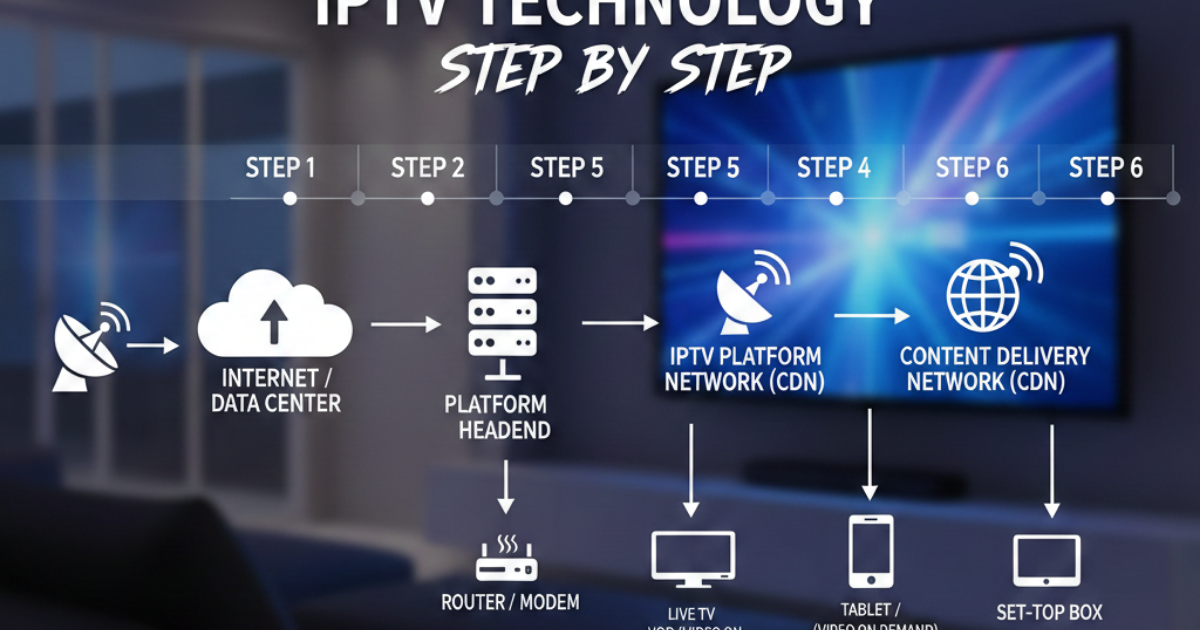
IPTV technology operates through a layered architecture: the stream originates at an ingest point, gets transcoded (typically to HLS or MPEG-TS), passed through a CDN or edge node, and delivered to your end user’s device. Every single handoff in that chain is a potential failure point — and under Saturday-afternoon load, weak links don’t bend. They snap.
The fundamental metric most UK resellers never track is concurrent connection ceiling vs. actual contracted capacity. Your supplier sells you 500 credits. What they don’t tell you is that those 500 credits share a pool with 8,000 other resellers on the same upstream infrastructure.
Effective Capacity=Total Upstream Bandwidth (Gbps)Total Active Connections×Avg. Bitrate per Stream (Mbps)\text{Effective Capacity} = \frac{\text{Total Upstream Bandwidth (Gbps)}}{\text{Total Active Connections} \times \text{Avg. Bitrate per Stream (Mbps)}}
Run that formula on a 10Gbps uplink shared across 4,000 simultaneous 4K HEVC streams pulling 25Mbps each — and the maths tells you there was never enough headroom. You just couldn’t see it from inside the panel.
Pro Tip: Before committing to any upstream supplier, ask specifically for their dedicated uplink capacity per reseller tier — not total infrastructure. If they can’t answer in Gbps, they’re overselling. Walk away.
The ISP Blocking Problem Is Now Driven by Machine Learning — Not Lists
Three years ago, ISP enforcement in the UK was reactive and slow. A domain would get flagged, a court order processed, and blocking implemented on a weekly cycle. Resellers adapted by rotating domains or switching to IP-direct delivery. That window is largely closed.
In 2026, major UK ISPs have deployed AI-assisted traffic analysis that identifies IPTV technology delivery patterns — not just domains. HLS segment request cadence, consistent inter-packet timing, and MPEG-TS encapsulation signatures are now detectable at the protocol level. DNS poisoning is still used, but it’s the blunt instrument. The precision tool is deep packet inspection triggered by behavioural fingerprinting.
What this means practically:
- Customers on residential FTTP connections from certain ISPs now see degraded streams even when the server is healthy
- VPN bypass rates have dropped as ISPs begin throttling tunnel traffic at peak hours
- Port 8080 and 1935 delivery is increasingly flagged, pushing serious operators toward HTTPS port 443 encapsulation
The resellers who’ve survived this shift aren’t the ones with the most credits. They’re the ones who understood IPTV technology at the transport layer and adapted their delivery method accordingly.
| Delivery Method | ISP Resistance | Stability at Peak | 2026 Viability |
|---|---|---|---|
| Plain HTTP (port 8080) | Very Low | Poor | Declining fast |
| HLS over HTTPS (443) | High | Good | Currently strong |
| VPN-encapsulated streams | Medium | Variable | ISP-throttled risk |
| Dedicated IP + FTTP bypass | Very High | Excellent | Best practice |
Credits, Churn, and the Psychology of Why Customers Leave
Nobody talks about churn psychology in this industry. Everyone focuses on acquisition — new trials, new resellers, new panels. Meanwhile, the average UK IPTV operation loses 30–40% of its subscriber base every 90 days, and the reason almost never appears in any support ticket.
The real churn driver in IPTV technology deployments is the gap between perceived reliability and actual reliability. A customer who experiences one 20-minute outage during a live football match doesn’t just cancel — they tell four people. They post in the Facebook group. They go back to whoever they came from.
Retention in this business is an infrastructure problem wearing a customer service mask.
Monthly Churn Rate=Cancelled SubsTotal Active Subs at Start of Month×100\text{Monthly Churn Rate} = \frac{\text{Cancelled Subs}}{\text{Total Active Subs at Start of Month}} \times 100
If your churn rate is above 15% monthly, your infrastructure — not your pricing, not your app, not your support — is the problem. And the fix isn’t a discount. It’s redundancy.
Pro Tip: Implement a secondary failover stream URL inside your panel for your top 20% of subscribers. When the primary CDN drops, active connections reroute automatically. Most customers never even notice the blip. Retention impact is measurable within 60 days.
How to Actually Evaluate IPTV Technology Before You Invest a Single Credit
The trial system in this industry is weaponised. Suppliers know that trial traffic is low-load, off-peak, and deliberately routed through their best infrastructure to close the sale. The stream you test on a Tuesday afternoon at 11PM tells you almost nothing about Saturday at 3PM.
Here’s how I actually vet IPTV technology infrastructure before committing:
- Request a stress test window — ask the supplier to give you 50 concurrent connections during a live sports event, not a quiet period
- Test geolocation latency — streams should originate from UK-based or EU-edge servers, not routed through transatlantic hops that add 80–140ms of unnecessary latency
- Check HLS segment length — 2-second segments handle network jitter far better than 6-second segments under congested conditions
- Monitor buffer-bloat indicators — open a second stream on the same connection while the first is live; if quality degrades immediately, their QoS is poorly configured
- Ask for uptime logs — any serious supplier running legitimate IPTV technology infrastructure can provide 30-day uptime history; if they can’t, that silence is the answer
A platform like IPTV Reseller UK provides exactly this kind of infrastructure transparency — UK-routed, 10Gbps+ uplink, with reseller-tier dashboards that show real connection health, not just credits remaining.
Read More: IPTV Reseller Panels
Scaling IPTV Technology: When to Add Resellers and When to Consolidate
Most operators scale horizontally when they should be scaling vertically. They add more resellers before stabilising the base infrastructure, and then wonder why quality complaints multiply faster than revenue.
The scaling decision in any IPTV technology operation should be driven by a single metric: headroom ratio — the percentage of unused capacity relative to your current peak load.
Headroom Ratio=Peak Capacity−Peak UsagePeak Capacity×100\text{Headroom Ratio} = \frac{\text{Peak Capacity} – \text{Peak Usage}}{\text{Peak Capacity}} \times 100
If your headroom ratio drops below 20% during a standard live sports weekend, you are not ready to add resellers. You’re one viral referral away from a collapse. The operators who’ve built sustainable UK businesses in this space — the ones still here after five years of enforcement waves — maintain a minimum 35% headroom buffer at all times. IPTV technology deployment at scale demands this discipline.
Pro Tip: Create reseller tiers based on their customer base stability, not just credit volume. A reseller with 50 long-term stable customers is more valuable to your infrastructure planning than one with 200 revolving-door trial users pulling random load spikes.
The 2026 Compliance Shift Operators Are Quietly Navigating
This isn’t legal advice. But any operator ignoring the regulatory environment around IPTV technology in 2026 is operating blind. The enforcement landscape has shifted from targeting end-users to targeting infrastructure providers and panel operators — particularly those with identifiable UK payment trails and registered business entities.
Smart operators are restructuring how their business touches IPTV technology services: separating technical and commercial operations, using compliant billing intermediaries, and maintaining explicit terms of service that place content responsibility at the subscriber level.
The conversations happening in serious reseller communities right now aren’t about which supplier has the best EPG. They’re about operational longevity — how to build a business around IPTV technology that survives the next enforcement wave, not just the current one.
✅ IPTV Technology Reseller Success Checklist
- Audit your supplier’s actual uplink capacity — demand Gbps figures, not credit counts, before your next renewal
- Deploy HLS over HTTPS (port 443) across all customer endpoints to reduce ISP fingerprinting exposure
- Calculate your churn rate monthly — if it’s above 12%, fix infrastructure before spending another pound on acquisition
- Implement failover stream URLs for your highest-value reseller accounts to protect retention during CDN incidents
- Test your panel under live sports load conditions — not trial conditions — before scaling your reseller network
IPTV Reseller UK is built specifically for UK operators who take IPTV technology infrastructure seriously — with transparent uplink specs, reseller-tier management tools, and the kind of technical foundation that holds up when Saturday hits.