

IPTV Live TV vs. VOD 2026: The Tactical ROI Audit Every UK Reseller Needs to Know
It was a Saturday afternoon. 3PM. Premier League fixtures were kicking off across the country, and I had 340 concurrent connections hammering a single server that was never meant to carry more than 200. Buffering complaints flooded in within minutes. Customers were furious — not because the VOD library was slow, but because the IPTV live TV vs VOD balance on my infrastructure was completely wrong. I’d over-allocated resources to a 60,000-title VOD catalogue that barely anyone used at peak time, and starved the live streams of bandwidth when it mattered most.
That one afternoon taught me more about the IPTV live TV vs VOD decision than any forum thread ever could.
If you’re building a reseller business in the UK right now, this isn’t a philosophical debate. The IPTV live TV vs VOD question is an infrastructure decision, a pricing decision, and ultimately a survival decision — and most new resellers get it badly wrong from the start.
Why the IPTV Live TV vs VOD Debate Actually Comes Down to Server Architecture
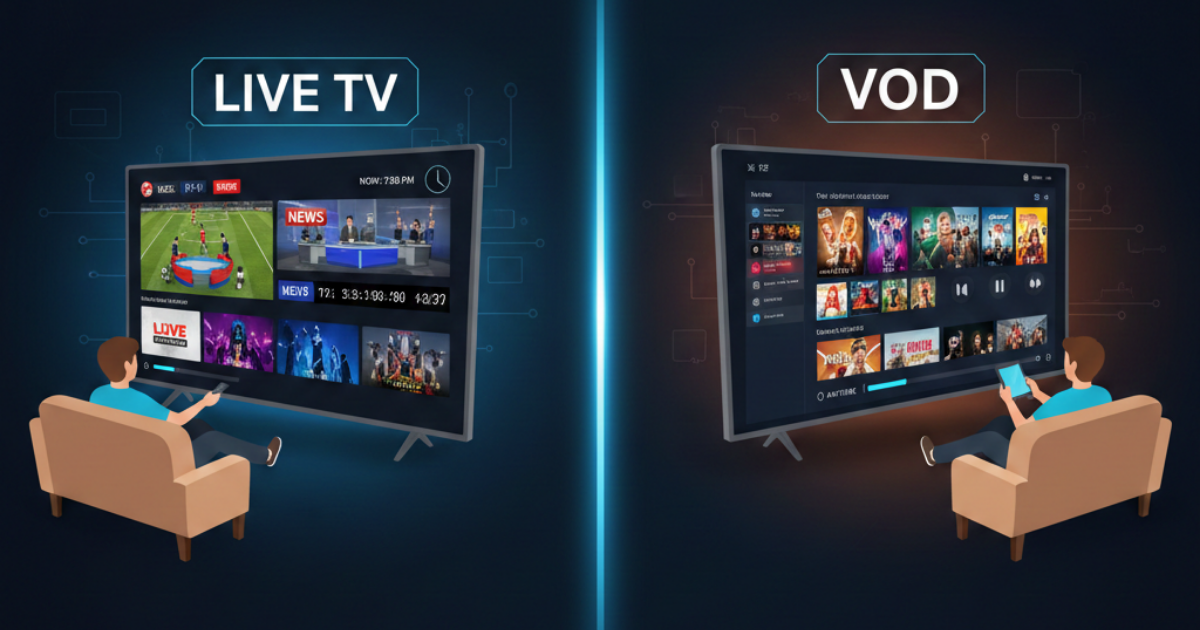
Most resellers think about IPTV live TV vs VOD in terms of content. That’s the wrong lens entirely. Think about it from a delivery architecture standpoint.
Live TV streams are persistent. A channel broadcasting a sports event is pulling a continuous feed, transcoding it in real-time, and pushing it to potentially thousands of simultaneous viewers. Every second of that stream matters. A 2-second freeze during a penalty shootout will cost you a renewal. The infrastructure demands are relentless and unforgiving — you need low-latency HLS, anti-freeze failover, and UK-based 10Gbps+ uplink servers that don’t buckle under concurrent load.
VOD, by contrast, is asynchronous. A customer starts a film at 11PM on a Tuesday. It buffers 30 seconds ahead. If there’s a brief spike, the buffer absorbs it. The tolerance window is measured in seconds, not milliseconds. You can get away with slightly less aggressive server specs on VOD — but only slightly, and only if your CDN is configured correctly.
Pro Tip: Never put your live TV streams and VOD library on the same origin server. Segment them at the infrastructure level. Live TV eats concurrent bandwidth; VOD eats storage I/O. Mixing them creates a bottleneck you can’t fix without downtime.
What the IPTV Live TV vs VOD Split Means for Your Pricing Model
Here’s where the IPTV live TV vs VOD debate gets commercially interesting. Most resellers sell a single subscription that bundles everything — live channels, catch-up, VOD — for one flat price. It’s the easiest thing to sell, but it’s not the most profitable structure.
When you understand IPTV live TV vs VOD as separate value propositions, you start to see the upsell architecture that premium panels are built around.
Consider this tiered model:
- Entry tier — Live TV only (sports, news, entertainment). Lower credit cost. High-volume, price-sensitive customers.
- Mid tier — Live TV + catch-up. Appeals to shift workers, families with irregular schedules.
- Premium tier — Full live TV + VOD library (4K HEVC catalogue). Highest margin. Lower churn.
The customers who pay for VOD access tend to stay longer. They’re building a habit around your service — Sunday film nights, box sets, documentaries. That’s retention behaviour you can bank on. The live-TV-only customer is one buffering complaint away from jumping to a competitor.
Monthly Reseller Margin=(Credits Sold×Markup per Credit)−Panel Cost−Churn Loss\text{Monthly Reseller Margin} = (\text{Credits Sold} \times \text{Markup per Credit}) – \text{Panel Cost} – \text{Churn Loss}
When you factor the IPTV live TV vs VOD model properly into your margin formula, VOD-inclusive packages reduce churn loss significantly — because the replacement cost of finding a new customer is always higher than retaining an existing one.
The Churn Psychology Behind IPTV Live TV vs VOD Customers
I’ve managed thousands of active lines across multiple reseller panels, and the behavioural difference between IPTV live TV vs VOD customers is stark and consistent.
Live TV subscribers churn on events. A bad experience during a high-profile match, a DNS poisoning wave that takes channels offline for 20 minutes, an ISP blocking incident that hits on a Friday night — these are the triggers. Their relationship with your service is emotional and reactive. You retain them through reliability, not content depth.
VOD subscribers churn on catalogue and UX. They leave when the library feels stale, when search is broken, or when their smart TV app stops working smoothly. They’re far less reactive to brief outages. You retain them through content breadth and app compatibility.
Pro Tip: Send a manual WhatsApp check-in to every VOD-heavy customer after their second month. Ask what they’ve been watching. It costs you 60 seconds and cuts 30-day churn by more than most resellers realise. Personal touch scales better than any automated drip campaign at the sub-500 line level.
How AI-Driven ISP Blocking in 2026 Has Changed the IPTV Live TV vs VOD Risk Profile
This is something almost nobody is discussing openly, and it directly changes how you should think about IPTV live TV vs VOD from a risk management perspective.
UK ISPs have progressively deployed machine-learning traffic analysis through 2025 and into 2026. The systems are specifically trained to identify live HLS stream signatures — the repeating segment request patterns, the persistent connection behaviour, the real-time bitrate consistency. IPTV live TV vs VOD traffic looks fundamentally different at the packet level, and live TV is the higher-profile target.
VOD traffic is structurally similar to standard HTTPS file delivery. Large objects, sequential requests, standard caching behaviour. It blends. Live TV is harder to disguise because the stream behaviour is inherently distinctive.
This doesn’t mean VOD is risk-free — it absolutely isn’t. But it means your live TV infrastructure needs a more aggressive approach to obfuscation, server rotation, and failover than your VOD delivery ever will.
| Factor | Live TV Infrastructure | VOD Infrastructure |
|---|---|---|
| Latency Tolerance | Sub-500ms critical | 2–5 seconds acceptable |
| ISP Block Risk | High (distinctive HLS pattern) | Moderate (resembles file delivery) |
| Server Load Pattern | Concurrent spike-heavy | Distributed, I/O-heavy |
| Anti-Freeze Required | Mandatory | Recommended |
| CDN Dependency | High | Medium |
Running IPTV Live TV vs VOD in Parallel Without Killing Your Panel Credits
Budget allocation is where the IPTV live TV vs VOD balance becomes a daily operational decision. Panel credits don’t care whether a line is streaming a 4K film or a live channel — a connection is a connection. But the value of that connection differs.
A live TV connection during a major sports event generates goodwill, retention, and word-of-mouth referrals when it works. When it doesn’t, it generates refund requests and public complaints. A VOD connection at 10PM generates quiet satisfaction. Nobody posts on Facebook because a film loaded correctly.
Pro Tip: Allocate no less than 60% of your server-side bandwidth headroom to live TV during peak windows (Saturday 12PM–10PM, Sunday 12PM–6PM). Throttle VOD transcode queues during these windows if your panel allows it. Your live subscribers are the loudest — protect them first.
The IPTV live TV vs VOD credit strategy should also differ. Offer your high-volume live TV customers 3-month or 6-month credit packages at a slight discount. Lock in the cash flow, reduce churn risk. For VOD-heavy customers, monthly renewals often work better because they’re more exploratory — give them the flexibility and they’ll keep coming back.
Which UK Reseller Panels Handle IPTV Live TV vs VOD Most Effectively
Not all panels treat the IPTV live TV vs VOD split with equal sophistication. Cheaper panels aggregate everything into a single stream pool with no segmentation. Premium panels — the ones worth building a business on — give you granular controls.
What to look for in a panel that genuinely supports the IPTV live TV vs VOD architecture properly:
- Separate bandwidth allocation controls for live vs VOD streams
- Per-stream quality caps (prevents a single VOD user from saturating a shared pipe)
- Real-time load monitoring with automatic failover for live channels
- VOD transcoding queue management
- Multi-server routing with geographic load balancing for UK traffic
IPTV Reseller UK is the platform I point UK-based resellers toward when this conversation comes up. The infrastructure is purpose-built around the IPTV live TV vs VOD segmentation that serious operators need — UK-based 10Gbps+ uplinks, anti-freeze failover on live channels, and a VOD CDN layer that handles catalogue delivery without cannibalising your live stream bandwidth.
Read More: IPTV Reseller Panels
IPTV Live TV vs VOD: Your 5-Step Execution Checklist
Before you launch or restructure your reseller offering around the IPTV live TV vs VOD model, run through this:
- Segment your server infrastructure — live TV and VOD must run on separate origin paths. Never shared.
- Build tiered pricing — live-only, live + catch-up, and full VOD tiers. Price the premium tier to reflect your true infrastructure cost.
- Identify your peak windows — Saturday and Sunday afternoons require pre-allocated bandwidth headroom. Don’t manage this reactively.
- Monitor churn triggers separately — live TV churn happens post-event; VOD churn happens at renewal. Track them independently and respond differently.
- Choose a panel built for both — visit IPTV Reseller UK to evaluate an infrastructure that handles the full IPTV live TV vs VOD split without compromise.
The resellers who are still operating profitably in 2026 are the ones who stopped treating IPTV live TV vs VOD as a content question and started treating it as an infrastructure and business model question. That shift in thinking is the difference between a hobby and a scalable operation.