

IPTV Streaming Protocols Explained: HLS vs MPEG-TS (2026 Guide)
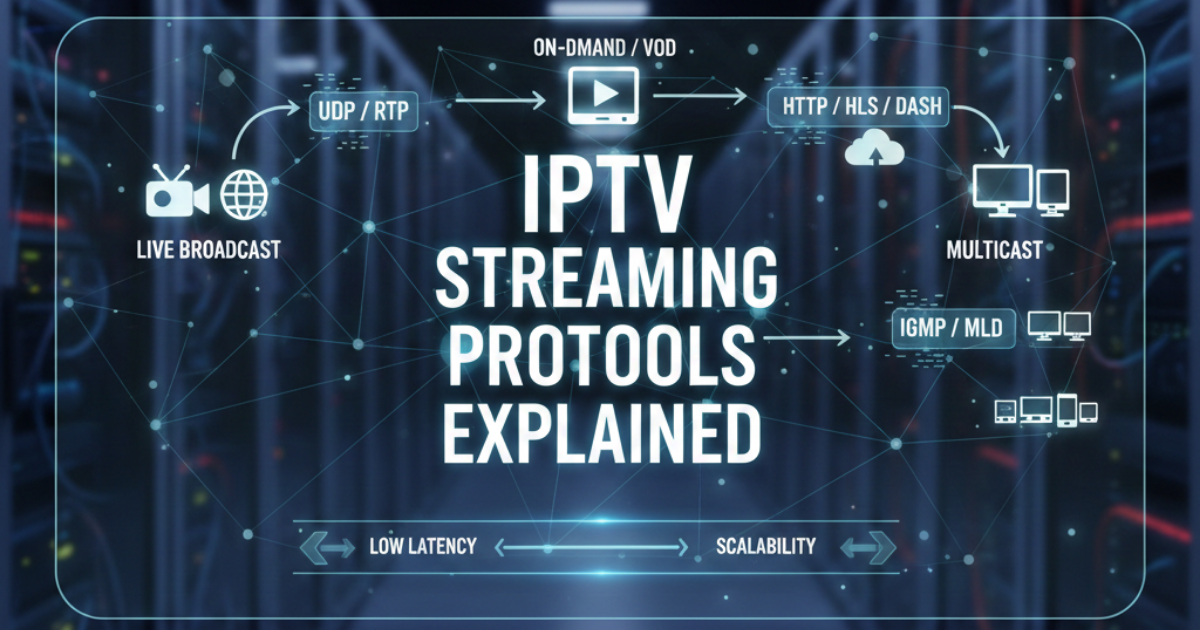
It was a Saturday afternoon. Premier League kickoff at 3PM. Forty-three customers online simultaneously, and the streams started stuttering — not crashing, just stuttering. That particular kind of failure is almost worse. Customers don’t rage-quit immediately. They sit there for ninety seconds refreshing, WhatsApping you, leaving one-star reviews before you’ve even diagnosed the fault. The culprit wasn’t the server load. It wasn’t the CDN. It was a misconfigured IPTV streaming protocol stack that nobody on the supply chain had bothered to explain properly.
If you’re running a reseller panel and you can’t tell the difference between HLS and MPEG-TS delivery at a technical level, you’re flying blind. This guide fixes that — without the textbook fluff.
What IPTV Streaming Protocols Actually Decide (And It’s Not Just Speed)
IPTV streaming protocols are the invisible architecture beneath every stream you sell. They determine how video data is segmented, transported, buffered, and reassembled on the viewer’s device. Choose the wrong protocol for the wrong device type, and you get buffering. Choose the right one with a poorly optimised server, and you still get buffering — just for different reasons.
There are two dominant IPTV streaming protocols you’ll encounter across UK reseller infrastructure in 2026:
- HLS (HTTP Live Streaming) — Apple-originated, segment-based, HTTP-delivered
- MPEG-TS (MPEG Transport Stream) — broadcast-native, low-latency, continuous bitstream
Both are valid. Both are used by serious operators. The difference is in application — which protocol fits which customer setup, which device type, and which server architecture.
Pro Tip: If your provider can’t tell you which IPTV streaming protocols their CDN defaults to under load, that’s a red flag. A serious infrastructure operator knows this down to the configuration level.
HLS: The Protocol That Took Over the Web (And Why It Creates Latency Problems)
HLS works by slicing a live video feed into small HTTP chunks — typically 2 to 10 seconds each — and delivering them sequentially via standard web servers. Because it rides on HTTP/HTTPS, it passes through firewalls, proxies, and ISP filtering with minimal friction. That’s exactly why it became dominant for consumer IPTV delivery.
But HLS introduces an inherent latency window. Every segment must be encoded, written to a server, and then fetched by the player. In real-world UK IPTV streaming protocol deployments, this translates to somewhere between 15 and 45 seconds of live delay under standard configurations. For general entertainment or VOD content, that’s irrelevant. For live sports during Saturday’s 3PM fixtures — it’s the difference between your customer seeing a goal before or after their neighbour hears the street react.
Advanced operators reduce HLS latency using Low-Latency HLS (LL-HLS), which cuts segment sizes to under 200ms. However, this requires server-side support and player compatibility — not every IPTV Smarters or TiviMate version handles it cleanly yet.
HLS works best when:
- Your customers are on iOS, smart TVs, or browser-based players
- You’re delivering VOD libraries at scale
- Your CDN has strong HTTP caching infrastructure
MPEG-TS: Why Legacy Broadcast Protocol Still Wins for Low-Latency IPTV Streaming
MPEG-TS was designed for broadcast television infrastructure — think satellite and digital terrestrial transmission. It delivers a continuous, fixed-bitrate stream rather than segmented chunks, which is why its latency profile is dramatically lower than HLS under equivalent network conditions.
In a well-configured UK IPTV streaming protocol environment running MPEG-TS over UDP multicast, live delay can sit as low as 2–4 seconds. That’s broadcast-comparable. For a customer watching a live football match, that’s the difference between a premium experience and an embarrassing one.
The trade-off is penetrability. UDP doesn’t negotiate with firewalls the way HTTP does. ISPs — particularly those deploying deep packet inspection in 2026 — can identify and throttle UDP-based IPTV streaming protocols far more aggressively than HTTP-wrapped HLS. This is one reason why the UK market has seen a gradual shift toward HLS despite MPEG-TS’s latency advantages.
Bandwidth Formula for MPEG-TS Reseller Planning:
Required Bandwidth (Mbps)=Concurrent Streams×Bitrate per Stream×1.15\text{Required Bandwidth (Mbps)} = \text{Concurrent Streams} \times \text{Bitrate per Stream} \times 1.15
(The 1.15 multiplier accounts for MPEG-TS protocol overhead and retransmission headroom)
For example: 200 concurrent streams at 8Mbps each requires a minimum uplink of 1,840 Mbps (≈1.84 Gbps) — before any redundancy buffer.
The Comparison Your Provider Doesn’t Want You To Run
| Factor | HLS | MPEG-TS |
|---|---|---|
| Live Latency | 15–45 seconds (standard) | 2–6 seconds |
| Firewall Penetration | Excellent (HTTP/HTTPS) | Poor (UDP-based) |
| ISP Block Resistance | High | Low–Medium |
| Player Compatibility | Universal | MAG boxes, STBEmu |
| VOD Performance | Excellent | Limited |
| CDN Caching Support | Full | Minimal |
| 4K HEVC Suitability | Moderate | High |
How ISP-Level Blocking in 2026 Targets Specific IPTV Streaming Protocols
This is the part nobody in the reseller community talks about openly enough. UK ISPs — under increasing legal pressure from major broadcasters — are no longer just blocking IP ranges. In 2026, the enforcement posture has shifted toward protocol-level identification.
Deep packet inspection now allows ISPs to fingerprint IPTV streaming protocol signatures within encrypted traffic. MPEG-TS streams, even when wrapped in TLS, carry identifiable packet size distributions and timing patterns. HLS traffic, by contrast, mimics standard CDN video delivery — making it significantly harder to differentiate from legitimate streaming services at the packet level.
What this means practically: resellers building MPEG-TS-first infrastructure are increasingly vulnerable to provider-side disruption, even when their own server isn’t directly targeted. Your upstream provider gets flagged, their UDP routes get poisoned via DNS, and forty customers ring you at once wondering why their MAG box went dead.
Pro Tip: The best-positioned reseller panels in the UK market now run dual-protocol infrastructure — MPEG-TS for latency-sensitive customers on compatible hardware, HLS fallback for everyone else. IPTV Reseller UK operates exactly this kind of layered IPTV streaming protocol architecture, which is part of why resellers on that platform experience fewer catastrophic outage events.
Read More: IPTV Reseller Panels
Choosing the Right IPTV Streaming Protocol Stack for Your Customer Base
The honest answer is: neither protocol wins outright. The resellers who scale consistently are the ones who match protocol delivery to customer profile.
If your panel has a high proportion of MAG box users — common in older UK customer demographics who set up their systems years ago — you need solid IPTV streaming protocol support for MPEG-TS delivery. Those boxes were designed for it. Forcing them onto HLS often creates stuttering simply because the box processor can’t handle the decoding overhead efficiently.
Conversely, if you’re onboarding customers via IPTV Smarters Pro or TiviMate on Android devices, HLS is cleaner. These apps are built for it. The player handles adaptive bitrate switching natively, which means your IPTV streaming protocols are effectively self-optimising based on the customer’s connection quality — reducing your support ticket volume noticeably.
A simple decision framework:
- Customer on MAG box / STBEmu → prioritise IPTV streaming protocol with MPEG-TS support
- Customer on Android / iOS / Smart TV → route through HLS-primary delivery
- 4K HEVC streams → evaluate MPEG-TS where ISP environment permits
- High-churn demographic (first 30 days) → HLS wins on reliability and cross-device tolerance
The panel you operate from directly affects how much control you have over these routing decisions. Entry-level reseller panels often lock you into one IPTV streaming protocol type. Premium platforms let you configure delivery per stream category.
5-Step Reseller Protocol Checklist
- Audit your current provider’s protocol stack — ask directly which IPTV streaming protocols are used for live vs VOD delivery. If they can’t answer, escalate or leave.
- Segment your customer base by device — MAG/STB users and app users need different protocol handling. Don’t treat them identically.
- Calculate your bandwidth floor using the MPEG-TS formula above — never launch a new package tier without this number confirmed with your upstream.
- Test LL-HLS compatibility on your most popular player apps before promoting it as a selling point — compatibility gaps still exist across TiviMate versions.
- Partner with a dual-protocol-capable panel — IPTV Reseller UK provides the infrastructure flexibility to serve both MPEG-TS and HLS customer segments without managing two separate upstream relationships.